Event Floristry and Structural Design: What Holds the Flowers Up
What separates credible event floristry from theatrical improvisation is structure: how weight is distributed, how hydration is maintained, and how installations behave over time.
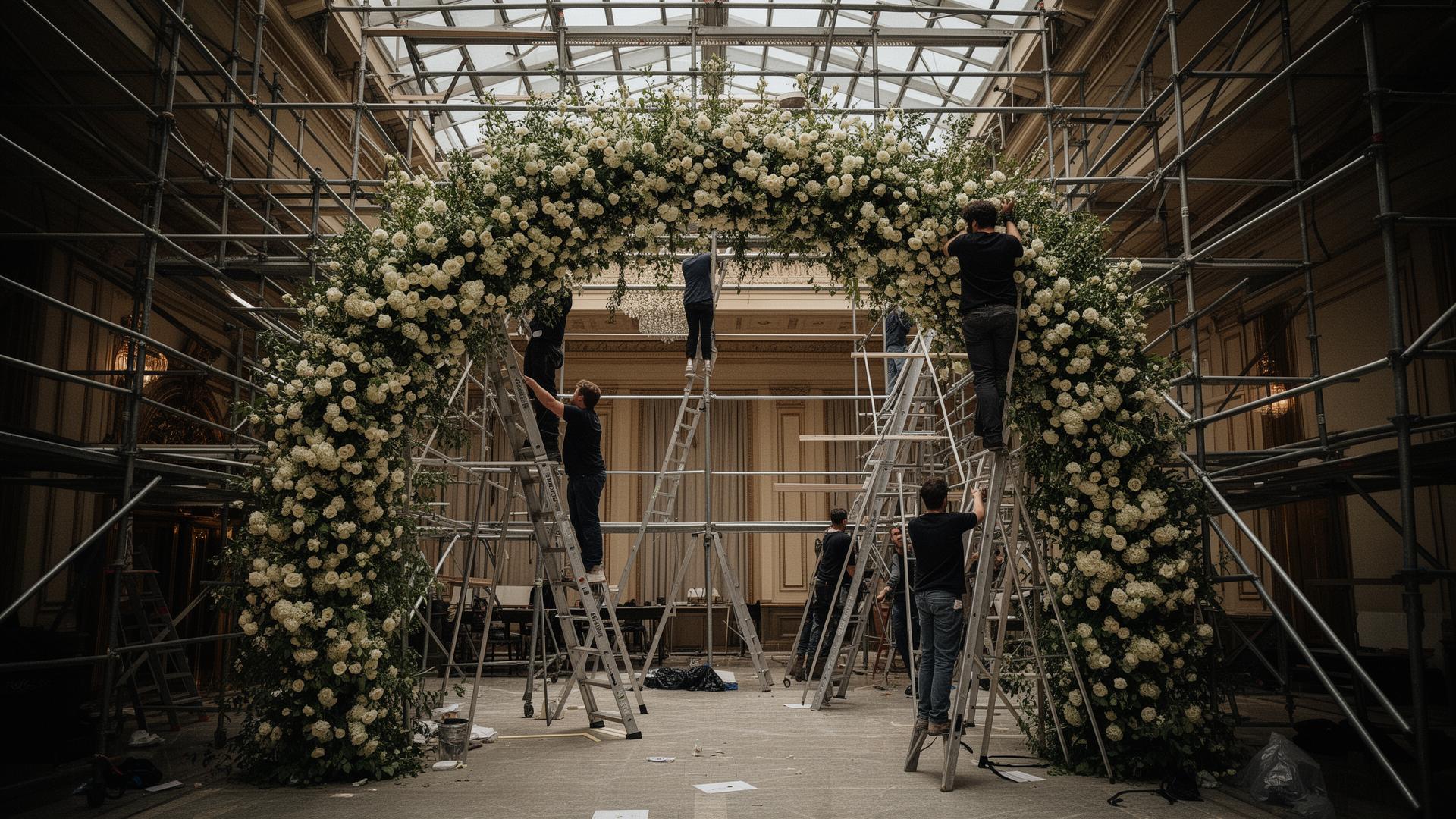
Event floristry is often judged by surface impression. Guests see arches, suspended installations, and overflowing tablescapes and assume the work is primarily decorative. In reality, large-scale floral design is as much about engineering as it is about aesthetics. What separates credible event floristry from theatrical improvisation is structure: how weight is distributed, how hydration is maintained, and how installations behave over time.
In New York City, where events unfold in nonstandard venues under tight timelines, structural competence is not optional. It is the difference between work that quietly endures and work that fails mid-event.
Scale turns flowers into load
At small scale, flowers are forgiving. At event scale, they become heavy, uncooperative, and time-sensitive. A fully hydrated floral arch can weigh hundreds of pounds. Centerpieces placed too densely trap heat and accelerate decay. Suspended installations introduce gravity as an active design constraint.
Professional event florists design with load in mind. They calculate how much floral material a structure can bear and how long it can bear it. Armatures are tested. Anchoring points are reinforced. Failure modes are anticipated.
Less experienced operators often underestimate these forces. They rely on visual references without understanding the physics behind them. The result may look impressive briefly, but it degrades unpredictably.
Mechanics are invisible by design
The best event floristry hides its mechanics. Chicken wire grids, water tubes, reinforced frames, and custom-built armatures disappear behind foliage and negative space. This invisibility is intentional. When mechanics are visible, it signals compromise.
Mass-market décor providers often default to floral foam because it simplifies construction. However, foam dries quickly, compresses under weight, and limits hydration. Many high-end event florists have moved away from foam entirely, not for ideological reasons, but because it performs poorly at scale.
This shift is widely discussed in professional education circles and trade press, yet it is rarely explained to clients. As a result, buyers may not understand why one proposal costs more than another for what appears to be similar work.
Time is the most underestimated variable
Events are not static. Installations are built hours before guests arrive. They must hold through heat, lighting, and human proximity. In NYC, delays are common. Elevators stall. Freight access is rescheduled. Install teams wait.
Florists who design structurally account for time as a stressor. They hydrate aggressively, design with airflow, and choose materials that age gracefully. Florists who do not are forced into last-minute fixes that compromise design.
This is why experienced event florists often limit how much floral density they use. Restraint is not minimalism. It is strategy.
Venue constraints shape design
New York venues impose unique constraints. Historic buildings restrict anchoring. Rooftops introduce wind. Landmark spaces limit installation methods. Fire codes restrict hanging elements.
Structural design begins with venue literacy. Florists who work repeatedly in NYC know which venues tolerate what. They design accordingly. Those unfamiliar with these constraints rely on assumptions that may not hold.
This knowledge is cumulative and rarely transferable. It is one reason why event floristry expertise is geographically specific.
Why this matters to clients
Clients often select event florists based on images alone. What they are actually selecting is a set of invisible competencies. Structural design determines whether an installation holds its shape, maintains hydration, and survives the event intact.
When failures occur, they are rarely catastrophic. They are subtle: drooping stems, collapsing forms, uneven aging. Guests may not articulate the problem, but they feel it.
Understanding the role of structure reframes evaluation. The most impressive event floristry is often the least dramatic on paper. It is the work that holds.
Sources: Professional event floristry education; NYC venue installation guidelines; trade discussions in Floral Management and related industry publications.
Published by the flowerdelivery.nyc Editorial Desk. Coverage is limited to New York City.