What Tariffs Did to the Price of a New York Bouquet
Nearly 80 percent of flowers sold in the United States are imported. When a duty lands on Colombian stems, it does not stay in Bogota. It arrives in New York as a quiet set of decisions about stem count, grade, and what gets substituted.
flowerdelivery.nyc Editorial Desk ·
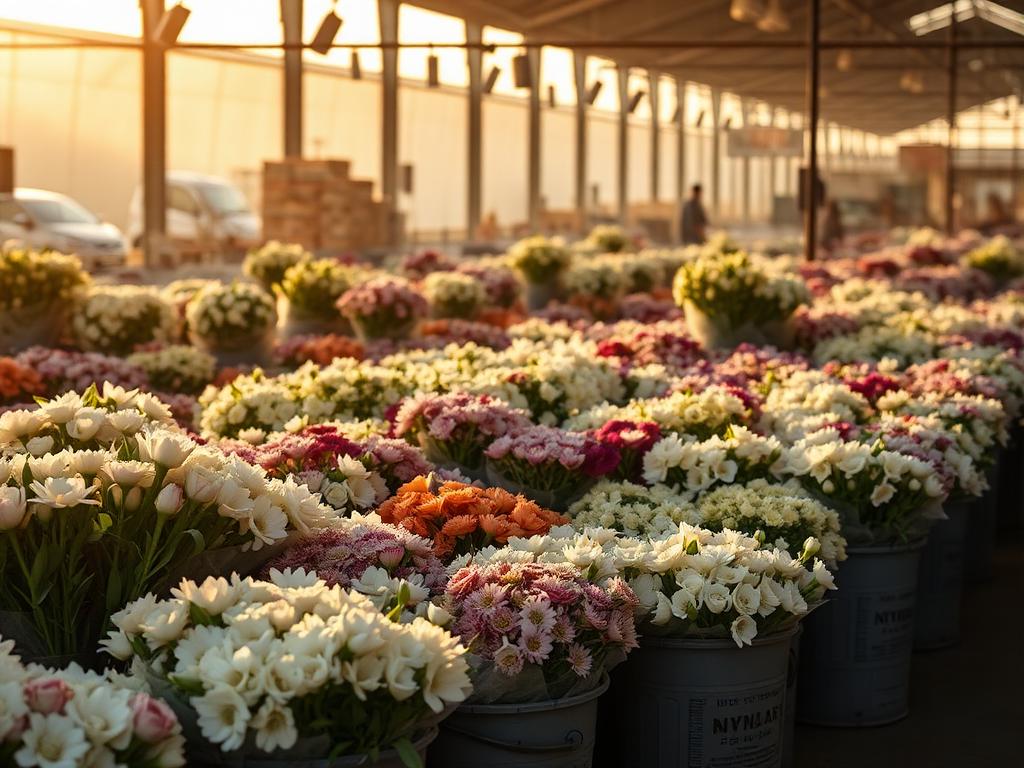
Most writing about flower prices in New York treats them as a matter of neighborhood, brand, or markup. That framing is comfortable and largely wrong. The single largest input into what a New York arrangement costs in 2026 is a trade policy decision made in Washington, applied at Miami International Airport, and absorbed, redistributed, or passed on by a chain of businesses that the buyer never sees.
This is not a story about whether tariffs are good or bad. It is a structural account of how a duty on imported stems travels through a supply chain and emerges, several weeks later, as a bouquet that looks slightly different from the one the same money bought two years ago.
The dependency nobody designed
The American cut flower market is import-dependent to a degree that surprises people who have never looked at the numbers. According to the USDA Foreign Agricultural Service, in a March 2026 report on the Colombian flower sector, nearly 80 percent of all flowers sold in the United States are imported. Colombia alone holds a 60 percent share of all U.S. flower imports by value, and roughly 80 percent of bouquets purchased by American consumers contain Colombian stems.
That dependency was built over six decades. The first commercial shipment of Colombian cut flowers left Bogota for Miami in October 1965. The sector is now worth approximately $2.4 billion in exports and employs more than 200,000 people, with production concentrated in the savanna around Bogota, which accounts for about 70 percent of output, and the Rionegro Valley near Medellin, which contributes 28 percent.
The logistics are equally concentrated. Flowers are the single most important cargo item at both El Dorado International Airport in Bogota and Miami International Airport. During peak season, 30 to 35 fully loaded flights per day leave Colombia for Miami. From there, roughly 30 companies operating hundreds of trucks distribute to cities across the country, New York among them. Air accounts for about 92 percent of export volume; ocean freight, at around 8 percent, remains a small though growing share.
No one designed this dependency as policy. It emerged because the economics worked, and because a highly perishable product rewards proximity, frequency, and reliable cold chain over almost everything else.
What actually changed
From May 2012, the U.S.-Colombia Trade Promotion Agreement eliminated tariffs on Colombian flowers entering the United States. That zero-tariff access underpinned more than a decade of expansion: between 2012 and 2025, Colombian flower exports rose 89 percent and cultivated area grew 71 percent.
In April 2025 a 10 percent duty was imposed, the first U.S. tariff on Colombian flowers in over a decade and a sharp reversal of the CTPA framework. Industry representatives estimate it adds more than $200 million in annual costs to the Colombian sector.
A note on precision, because this matters for anyone making purchasing decisions on the strength of it: the 10 percent figure is the rate documented by USDA FAS as of its March 2026 reporting. Trade publications have since reported further movement in the rate, including an increase in July 2026, and they do not agree with one another on the exact figure or its scope. We are citing the number we can source to a primary government document and flagging the rest as unsettled. Anyone pricing a large contract should verify the current rate against the Harmonized Tariff Schedule directly rather than against any publication, this one included.
The squeeze is three-sided, not one-sided
Treating the tariff as the whole story understates the pressure on the supply side considerably. Three forces converged on Colombian growers at once, and they attack from both the revenue and the cost side of the ledger.
The tariff reduces net export earnings. A 23.7 percent minimum wage increase took effect in January 2026, and because labor accounts for 50 to 60 percent of total production costs and approximately 85 percent of flower workers earn the minimum wage, that increase moved nearly the entire cost base simultaneously. Meanwhile the Colombian peso appreciated nearly 12 percent against the dollar, which compresses margins for an industry that earns in dollars but pays wages and operating costs in pesos.
Industry leaders have described the combined effect as an unprecedented margin squeeze, with warnings that sustained pressure could produce layoffs and farm closures. Whether that materializes is not yet knowable. What is knowable is that the cost of producing a stem rose from several directions at once, and that costs of that kind do not stay where they land.
Why the increase does not appear as a line item
Here is the part that confuses buyers. Very few New York florists added a visible surcharge. Almost none sent a letter explaining that stems cost more. Yet the arrangement changed.
A duty applied at the border is absorbed in stages. The grower takes some. The importer takes some. The wholesaler takes some. By the time the cost reaches a retail florist, it is no longer a discrete number that can be passed along cleanly. It is a general upward pressure on the cost of everything in the cooler, arriving unevenly across varieties and grades.
Florists have three levers, and they are used in roughly this order. The first is stem count: the same price buys fewer stems, with the composition adjusted so the arrangement still reads as full. The second is grade substitution: a shorter-stemmed or smaller-headed rose of the same variety costs materially less and is visually similar in a photograph, though not in the hand. The third, and the one most likely to be noticed later, is variety substitution, where a specified flower is replaced with a cheaper analogue.
None of these are deceptive by default. All three are legitimate responses to input costs. What separates a credible operation from an evasive one is whether the substitution is disclosed before the arrangement is made, not after it arrives.
What this looks like in New York specifically
New York amplifies the effect for reasons that have nothing to do with flowers. Commercial rent, labor, refrigeration, and last-mile delivery in a dense city with building access restrictions all sit on top of the stem cost. A cost increase that a suburban grocery floral department can absorb across volume has nowhere to hide in a studio operation producing a few dozen arrangements a day.
This is where the business models diverge sharply. Operations that compete primarily on price and volume, including wire services and mass-market platforms, have the strongest incentive to manage the increase invisibly, because their offer is built on a fixed price point that the customer has already anchored to. Studio florists, who source daily from the wholesale market and build to order, tend to have the opposite incentive: their work is judged on what arrives, and a thin arrangement damages them more than a frank conversation about cost would.
In practice that means the useful question has shifted. It is no longer "what does this cost?" but "what am I getting for this, and what happens if the market does not have it?" Studios in the city handle that question differently and openly, and it is worth asking several. Alaric Flower Design publishes case studies of completed work that show specification and outcome together, which is a reasonable standard to hold any studio to. Putnam Flowers, Saipua, and Winston Flowers each take a different approach to sourcing and disclosure. The point is not which name you choose. It is that the choice is now a sourcing question rather than a style question.
How to read a price in 2026
Three questions separate a priced arrangement from an unpriced one.
Ask what the stem count is, not what the arrangement looks like in the photograph. Photographs are taken at peak and composed for the lens; stem count is a number that survives translation.
Ask what the substitution policy is before you order. A studio that sources daily will tell you plainly that market availability governs and that they will call you if a specified flower is unavailable. A platform that cannot tell you where the flowers come from cannot tell you what will replace them.
Ask what grade is being used, if the arrangement is roses. Stem length and head size are the levers that move cost most and photograph least.
What is still uncertain
The forward picture is genuinely open, and it would be dishonest to pretend otherwise.
Colombia held a relative advantage for more than a decade because competitors from non-FTA countries faced higher duties, Ecuador's roses among them at 6.8 percent. The USDA report notes that as the United States pursues new bilateral agreements, competitors currently facing higher duties could gain preferential access, potentially eroding Colombia's cost advantage. If that happens, the sourcing mix available to New York buyers shifts again, and so do the varieties that are economical to stock.
For buyers, the practical implication is modest but real. The era in which a given price reliably bought a given arrangement has ended, at least for now. What replaces it is a market in which asking precise questions produces materially better outcomes than brand recognition does.
Sources: USDA Foreign Agricultural Service, "Colombian Flowers and the American Market After Six Decades of Growth," Report CO2026-0004, Bogota, March 24, 2026, which is the source for all tariff, employment, export value, share, wage, currency, and logistics figures cited above. The USDA report in turn draws on Asocolflores, Trade Data Monitor, ICA, Reuters reporting of February 2026, and Mordor Intelligence. Current duty rates should be verified against the Harmonized Tariff Schedule of the United States, as trade publications reporting subsequent rate changes do not agree with one another.
Published by the flowerdelivery.nyc Editorial Desk on . Coverage is limited to New York City.
Related reading
- Ordering Flowers in New York in December: What the Calendar Actually Demands
December floristry in New York is not a design problem. It is a logistics problem wearing design clothing, governed by building access, freezing transit, and a corporate calendar that collapses into four working days.
- New York Floristry in 2026: What Actually Changed
A year in which the cost base moved, the retail channel kept shifting toward the supermarket, and the 2027 calendar quietly set up the tightest February the trade has faced in years.
- What Flower Delivery Really Means in New York City
Understanding the fragmented ecosystem of business models, from studio florists to wire services, and why accountability matters more than brand recognition.